
The security incident postmortem is where organizations either learn or repeat. I’ve sat through reviews that transformed how teams operated, and I’ve endured sessions that were little more than public executions disguised as process improvement. The difference has nothing to do with the severity of the incident. It has everything to do with how the review is conducted.
After the immediate crisis passes and systems are restored, you face a choice. You can run a review that surfaces real problems and builds trust. Or you can run one that assigns blame, buries root causes, and guarantees you’ll face the same failure again. Most organizations default to the second approach without realizing it.
Why Most Security Incident Postmortems Fail
The typical postmortem follows a predictable pattern. Leadership wants to know what happened. Someone is identified as responsible. That person is punished, formally or informally. The organization declares the problem solved and moves on.
This approach feels satisfying. It provides closure. It demonstrates accountability. It also guarantees the organization learns nothing useful.
When people know the postmortem is about finding who to blame, they protect themselves. They shade their accounts. They omit details that might implicate them or their colleagues. They focus on procedural compliance rather than what actually happened. The review becomes a legal proceeding, not a learning exercise.
The information you most need is the information people are most motivated to hide. Why did someone bypass a control? What warning signs were ignored? What shortcuts had become normalized? These questions only get honest answers when people believe honesty won’t be used against them.
The Blameless Approach
Blameless doesn’t mean unaccountable. It means separating the analysis of what happened from decisions about individual performance. Google’s Site Reliability Engineering team pioneered this approach and documented it extensively. You can’t do both in the same conversation. The moment people think their jobs are at stake, the quality of information plummets.
A blameless security incident postmortem operates on one core assumption: the people involved were doing their best with the information and resources they had at the time. If someone made a decision that looks obviously wrong in hindsight, the interesting question isn’t “why did they make that mistake.” It’s “what made that decision seem reasonable in the moment.”
That reframe changes everything. Instead of finding the person who failed, you find the system that made failure likely. Instead of punishing an individual, you fix the conditions that will cause the next individual to fail the same way.
Running the Review
Set the Tone Early
Open by stating explicitly that this is a learning exercise, not an investigation. “We’re here to understand what happened so we can improve. We’re not here to assign blame.” Say it directly. Say it more than once. People need to hear it and believe it before they’ll participate honestly.
If leadership in the room has a history of punishing people after incidents, your words won’t be enough. They’ll watch behavior, not listen to statements. This is why blameless culture has to be built over time, not declared in a meeting.
Build the Timeline First
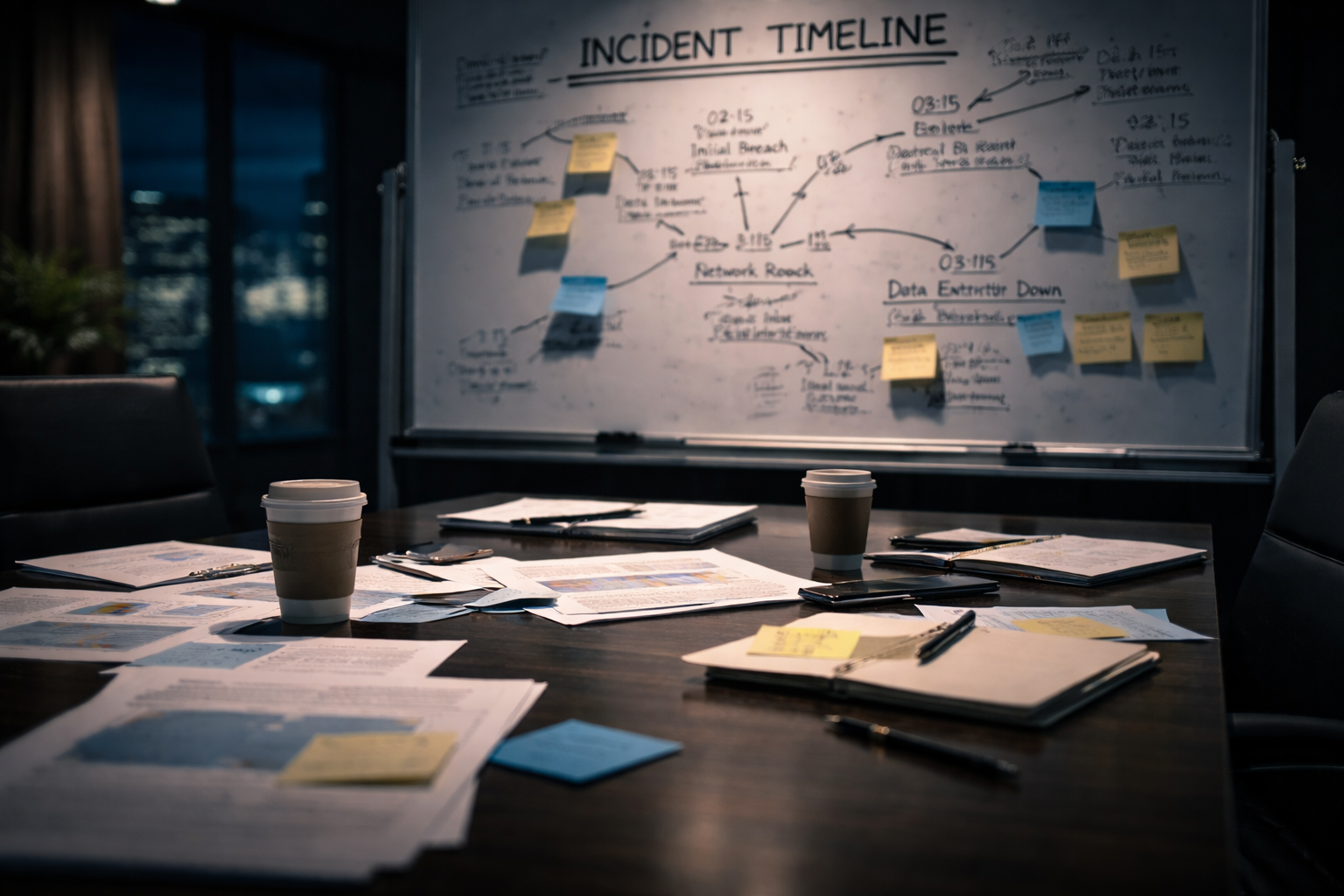
Before analyzing anything, establish what actually happened. Walk through the incident chronologically. What was the first indication? Who noticed it? What actions were taken and when? What information was available at each decision point?
The timeline should be factual, not interpretive. “At 2:15 PM, the analyst escalated to the security manager” is factual. “The analyst waited too long to escalate” is interpretive. Save interpretation for later. Get the facts straight first.
Expect the timeline to have gaps and contradictions. People remember things differently, especially under stress. The first 24 hours of a breach are chaotic, and memories formed during chaos are unreliable. Use logs, tickets, and messages to anchor the timeline where possible.
Ask Why, Not Who
Once the timeline is established, dig into the decisions that shaped the outcome. For each decision point, ask: What information was available? What options were considered? What pressures or constraints influenced the choice?
When someone clicked a phishing link, the interesting question isn’t their security awareness score. It’s why the email reached them, why it was convincing, why the link wasn’t blocked, and why the resulting compromise wasn’t detected sooner. The human action is just one link in a chain of systemic factors.
Use the “five whys” approach carefully. Keep asking why until you reach something the organization can actually change. “The analyst didn’t check the header” leads to retraining, which rarely works. “The analyst was handling sixty alerts that day and triaging quickly to keep up” leads to workload analysis, which might actually help.
Identify Contributing Factors, Not Root Cause
Complex incidents rarely have a single root cause. They have multiple contributing factors that aligned to create failure. The NIST incident handling guidance reinforces this systems-thinking approach to analysis. The analyst was overloaded. The detection rule had a gap. The runbook was outdated. The escalation path was unclear. Remove any one of these, and the outcome might have been different.
Chasing a single root cause creates tunnel vision. It also creates pressure to find someone or something to blame. Listing contributing factors acknowledges complexity while surfacing multiple opportunities for improvement.
Turning Findings Into Action
A postmortem that doesn’t produce change is just documentation. Every contributing factor should generate a question: can we reduce the likelihood of this contributing to future incidents? Some factors will be addressable. Others won’t, or won’t be worth the investment. Be explicit about which is which.
Prioritize action items ruthlessly. A postmortem that generates twenty action items will accomplish none of them. Pick the two or three changes with the highest impact-to-effort ratio. Assign clear owners and deadlines. Track completion in a visible way.
Avoid the temptation to add process as the default fix. More checklists, more approvals, more mandatory training. These feel like action but often just add friction without reducing risk. Ask whether the proposed fix would have actually prevented this incident. If the honest answer is “probably not,” find a different fix.
Documentation That Serves a Purpose
Write the postmortem report for future readers, not current stakeholders. Six months from now, someone will face a similar situation. What do they need to know? What context will they be missing? What decisions seem obvious now but won’t be obvious then?
Include what you considered and rejected, not just what you did. “We considered blocking all external USB devices but determined the operational impact was too high given our current remote work policy” is useful context. Without it, the next reviewer will waste time proposing the same solution.
Be honest about what you still don’t know. Some questions won’t have answers. The attacker’s initial access vector might remain unclear. The full scope of data access might be uncertain. Document these gaps rather than papering over them. Uncertainty acknowledged is more useful than false confidence.
Building the Culture
Blameless postmortems require trust, and trust requires consistency. One punitive review undoes the credibility built by ten blameless ones. People remember how the worst incident was handled, not the average.
Leadership behavior matters more than policy. If executives demand to know who was responsible, your blameless process is dead regardless of what the documentation says. Align leadership expectations before the incident, not during the postmortem.
Share postmortems broadly. Transparency reinforces that these are learning exercises, not cover-ups. When people see that honest accounts don’t result in punishment, they’re more likely to be honest in future reviews. When they see real changes resulting from findings, they’re more likely to engage seriously.
The best security teams I’ve worked with treat incidents as learning opportunities, not failures to hide. They talk about what went wrong openly. They celebrate near-misses that revealed gaps before attackers found them. They understand that the alternative to learning from incidents is repeating them.
A security incident postmortem done well makes your program stronger. Done poorly, it just makes people better at hiding problems. The approach you choose determines which outcome you get.